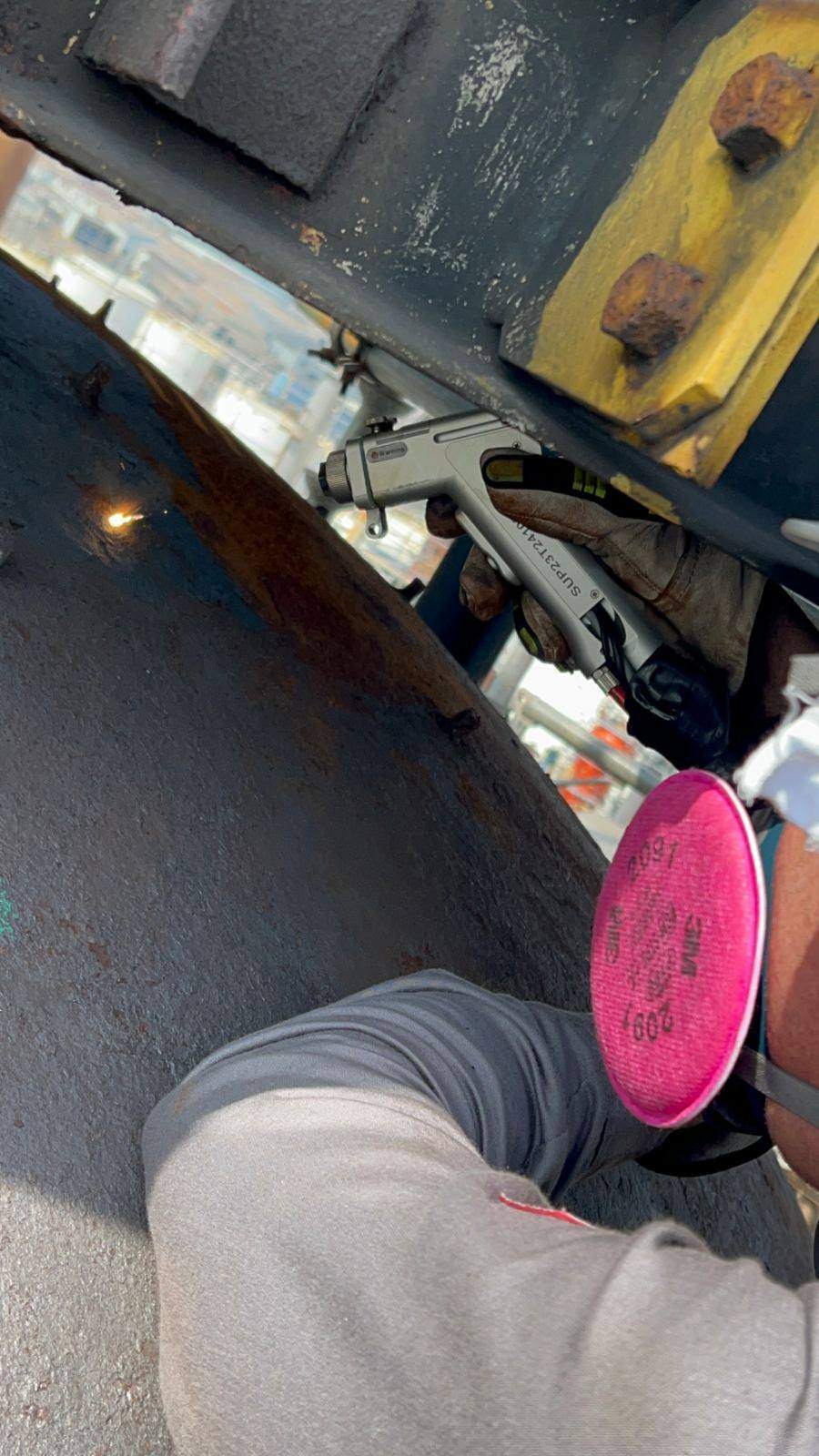
Laser safety in industrial facilities
Laser cleaning is often sold as the safe alternative to blasting. It is more accurate to say it trades one hazard set for another. Here is the one it introduces, and the controls that make it workable inside a live plant.
- Classification
- Class 4 laser
- Open-area perimeter
- Around 20 ft barricade
- Measured noise
- 68 dB average
- Service leads
- 60 ft (2,000 W), 100 ft (3,000 W)
- Confined space
- Source and generator outside
Class 4 systems
At 2,000 W and 3,000 W, these are Class 4 lasers: the highest hazard classification. The beam and its reflections can cause eye and skin injury, and can ignite combustible material. That is not a reason to avoid the method; it is a reason to control it properly, the same way hot work is controlled.
Controlled area
A defined perimeter with controlled access.
In open-area work Extrinite establishes a barricade perimeter of around 20 ft. Everyone inside needs appropriate eyewear and PPE.
Fume and particulate
Ablation converts the contaminant into dust and fume.
Extraction is matched to the material: fresh-air supply for non-hazardous coatings, HEPA filtration where constituents such as lead or asbestos are present.
Noise
Measured at 68 dB average.
Hearing protection is required: a point frequently missed when the method is described as “quiet” relative to blasting.
Coating chemistry
What comes off the surface is what goes into the air.
The coating being removed determines the extraction requirement.
Confined space practice
The arrangement below is Extrinite's standard confined space configuration, and the electrical separation is the part worth understanding.
Why the separation matters
Keeping high voltage out of the vessel removes the electrical hazard from inside the space entirely. Service leads are bundled and kept separate from the power cable, and reach a maximum of 60 ft from the source on the 2,000 W and 100 ft on the 3,000 W, for taller columns the source is repositioned during execution.
Stays outside the space
- Laser unit
- 150 kVA generator
- 480 V input cable: between generator and laser only, never enters the space
- Air and water lines: enter via the manway, bundled
Enters via the manway, bundled
- Fiber optic cable
- 12 VDC communications
Atmospheric monitoring
- Continuous monitoring for oxygen, LEL, H₂S and CO
- Airflow direction and rate confirmed before the laser starts
- Confined space permits and standby attendants in place
PPE in confined spaces
- Tyvek coveralls
- Externally supplied fresh-air hood
- Full-face respirator worn inside the hood
- Hearing protection
- Steel-toe boots and hard hat
- Cut and impact resistant gloves
- Personal 4-gas monitor
Simultaneous operations
Other trades can work in the same area, which is one of the practical arguments for the method on a congested site. It is conditional: Class 4 laser controls and appropriate fume extraction have to be in place first, and the perimeter maintained.
From the test reporting
Extrinite's test reporting notes SIMOPS as a specific advantage of the method, alongside the fact that a prepared surface can be painted immediately without a cleanup step.
Frequently asked questions
For other questions, call 346.217.6583 or email info@extrinite.com.
Are these Class 4 lasers?
Yes. Industrial laser cleaning systems at these power levels are Class 4, which is the highest hazard class. They require a controlled work area, appropriate eyewear, trained operators and extraction matched to the material being removed.
Is laser cleaning safer than blasting?
It is not automatically safer. It removes abrasive media, silica exposure and the associated containment. It introduces a beam hazard, fume from whatever is being ablated, and measured noise of 68 dB. Both methods are safe when properly controlled and dangerous when not.
How do you work inside a vessel?
The laser unit and the generator stay outside. Only low-voltage service leads enter: fiber optic, 12 VDC communications, air and water. The 480 V supply cable never enters the confined space. Continuous atmospheric monitoring, permits and standby attendants apply as they would for any confined space entry.
What about hazardous coatings?
Where coatings contain constituents such as lead or asbestos, extraction runs through a HEPA filtration unit so particulate is captured rather than released. Identify hazardous constituents before the job so ventilation is specified correctly.
Talk through site requirements
Tell us where the work is, what is being removed and what your permit process requires. We will tell you what the setup involves.