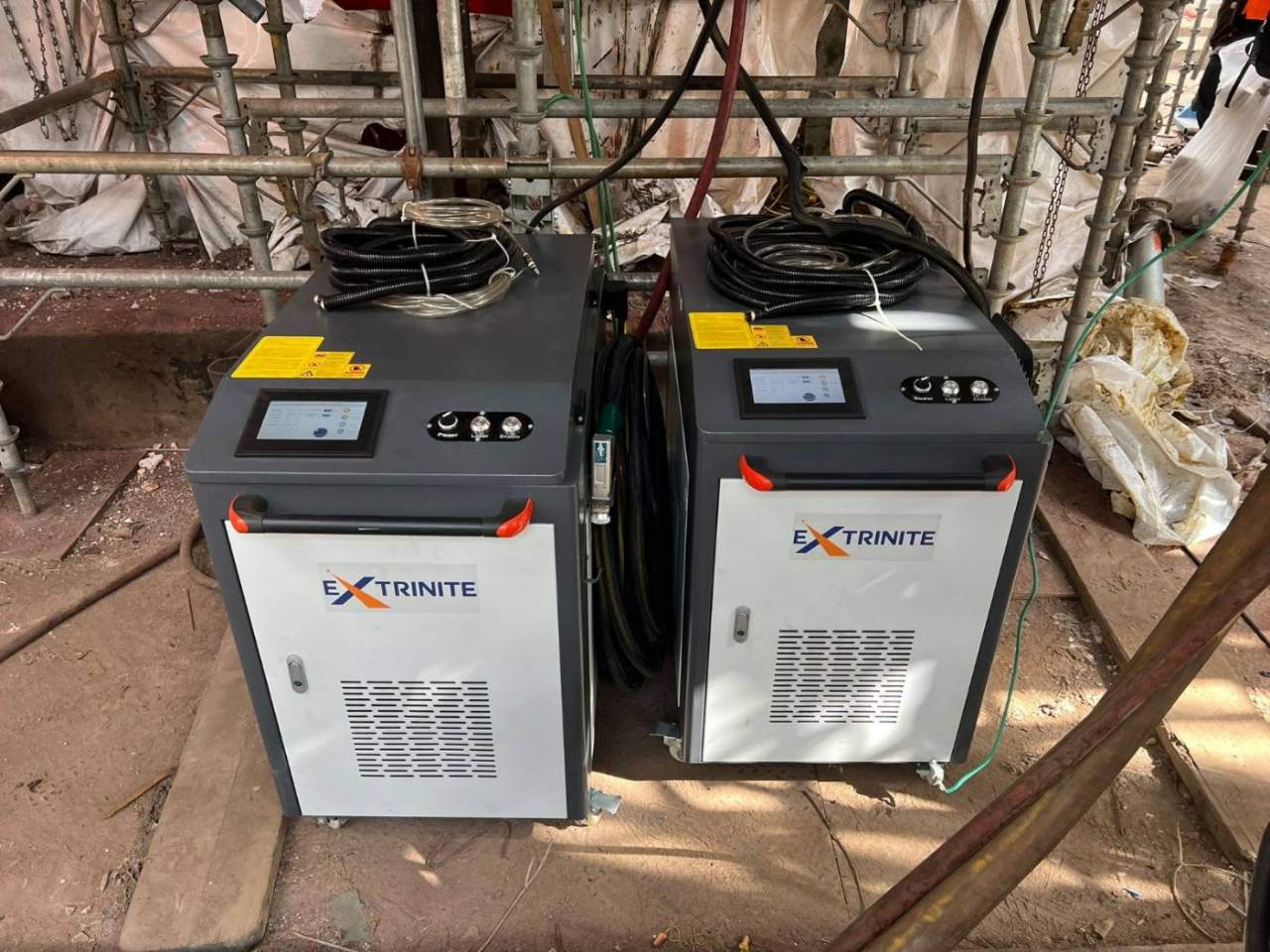
2,000 W and 3,000 W system specifications
Full specifications for both rental systems. If you are deciding between them, the determining factors are available site power, the type of work and access, and cleaning width.
- Laser
- Continuous wave fiber, 1064 nm
- Cleaning width
- 6 in (2,000 W), 12 in (3,000 W)
- Electrical input
- 220 V at 30 A (2,000 W), 480 V at 50 A (3,000 W)
- Weight
- 265 lb (2,000 W), 375 lb (3,000 W)
- Service leads
- 60 ft (2,000 W), 100 ft (3,000 W)
Specifications
Both systems are continuous wave fiber lasers with integrated water cooling, a 100% duty cycle and touch screen control.
| 2,000 W systemStandard system for most work, including small components and complex geometry | 3,000 W systemLarger, more extensive scopes of work | |
|---|---|---|
| Laser type | Continuous wave (CW) fiber | Continuous wave (CW) fiber |
| Rated output power | 2,000 W | 3,000 W |
| Wavelength | 1064 nm | 1064 nm |
| Cleaning width (adjustable) | Up to 6 in (150 mm) | Up to 12 in (300 mm) |
| Operation mode | Continuous, 100% duty cycle | Continuous, 100% duty cycle |
| Cooling | Integrated water cooling | Integrated water cooling |
| Electrical input | 220 V single phase at 30 A | 480 V at 50 A |
| Approximate dimensions | 1.5 ft × 2 ft × 2 ft | 3 ft × 4 ft × 4 ft |
| Approximate weight | 265 lb | 375 lb |
| Control | Touch screen: power, scan speed, frequency, line width and pattern all adjustable | |
| Service lead reach | 60 ft from the laser source | 100 ft from the laser source |
| Measured noise | 68 dB average: hearing protection required | |
Choosing a system
Substrate, coating type and thickness, surface condition, required finish and site power all affect the outcome.
How we recommend a system
Send us the job and we will tell you which system fits, or tell you if laser ablation is the wrong method for it. How it compares with abrasive blasting
Choose the 2,000 W when
Choose the 3,000 W when
Available site power is 220 V single phase
480 V is available
Work is localized: repair areas, weld zones, inspection windows
Surfaces are large and continuous: tank shells, structural steel
Access is tight or geometry is complex
Access is open
Adjacent coating must be protected and feathered into
Coverage per shift is the binding constraint
The unit must be carried or lifted into position (265 lb)
The unit can be positioned by equipment (375 lb)
What these systems remove
Each material lists what to confirm before you rely on the method.
Rust, mill scale and oxide
Corrosion removal, inspection preparation
Confirm first. Surface condition. Performance drops on new carbon steel with mill scale and on highly reflective surfaces, where the beam is deflected.
Organic coatings and paint
Localized coating removal, repair areas, recoat preparation
Confirm first. Coating system and film thickness. Thick films need multiple passes and are slower.
Hydrocarbons and oils
Process equipment decontamination
Confirm first. Residue type and substrate.
Soluble salts and chlorides
Pre-coating and pre-inspection decontamination
Confirm first. Verify salt levels with the project-specified test method, such as Bresle.
Silver brazing
Component reclamation
Confirm first. Tested on PDC cutters: effective at around 30% power, but leaves surface marking. An ideal setting that avoids marking has not yet been identified.
Documented coating removal results
From Extrinite's own test reporting on two pipeline coating systems:
- Denso Protal 7200: removed swiftly and completely down to the substrate
- 35–43mils
- SW Duraplate UHS: considerably more difficult; a hard edge left by a previous pull test could not be removed
- 50–70mils
- Power range tested; both coatings were ablated in layers, with removal increasing as power rose
- 10–30%
- Profile achieved once the substrate was reached
- 2.5–3.5mils
- Plate surface temperature, rising at the high output setting
- 99–272°F
Surface finish and profile
On rusted surfaces with correctly set parameters, these systems produce a cleaned surface with a measurable anchor profile suitable for most organic coatings. Extrinite's equipment data sheets give this result as SSPC-SP 10 / NACE No. 2 near-white cleanliness with a 1–2.5 mil profile.
Cleanliness and profile in your specification
Your coating specification will state a cleanliness requirement and a profile requirement. Those are two separate acceptance criteria, measured separately. Confirm with your coating manufacturer and your inspector that a laser-prepared surface meets the specification you are working to, and agree the acceptance method before work starts.
- Anchor profile on rusted surfaces, Extrinite operations guidance
- 1–2.5mils
- Measured in coating-removal testing once bare substrate was reached
- 2.5–3.5mils
Site requirements
Four things to have in place before delivery. Pick one to see its checklist.
Power
- 220 V single phase at 30 A for the 2,000 W
- 480 V at 50 A for the 3,000 W
- Supply at the work location, not elsewhere in the building
- Distance from the panel confirmed
- A generator arranged if there is no site power
Gas and air
- Nitrogen, argon or compressed air, as the system requires
- Compressed air that is dry and oil free
- Air at 40 psi and 5 cfm
- A nitrogen generator or chiller from Extrinite, where appropriate
Ventilation
- Open area: typically no ventilation, with a barricade perimeter of around 20 ft
- Enclosed work: a continuous fresh-air supply
- Lead or other hazardous coatings: HEPA filtration
- Extraction matched to the material being removed
Controlled area
- A Class 4 laser controlled area with restricted entry
- Eyewear and PPE for everyone inside it
- Hearing protection: noise measured at 68 dB
- Someone at your site who approves the work area
Equipment in the package
What goes to site with each system.
| Item | 2,000 W | 3,000 W |
|---|---|---|
| Laser cleaning system | Included | Included |
| Transformer | Not part of the package | Included |
| Chiller or nitrogen generator | Included | Included |
| Equipment | Available for purchase | Available for purchase |
Limits
What these systems do not do, from Extrinite's own testing.
They are not the fastest method for large-area bulk removal
Extrinite's own testing records laser production rates as slower than traditional sandblasting on thick coatings.
Where you need to strip and profile very large areas, abrasive blasting is generally quicker. Laser ablation earns its place on localized work, restricted areas, and surfaces where blast media, water or containment create problems.
They do not restore metal lost to corrosion
Laser cleaning removes corrosion products from the surface.
It does not replace wall thickness, and CUI work may still require ultrasonic thickness measurement and engineering assessment.
They perform poorly on reflective surfaces
Highly reflective materials deflect the beam.
New carbon steel with mill scale is also a weak application.
Thin substrates need care
Reduced settings are used to avoid thermal damage, and substrate temperature is monitored during work.Results vary by coating
Two pipeline coatings of similar thickness behaved very differently in the same test program.
Testing on a representative sample is the only reliable answer. Book a test on your coating
They are Class 4 lasers
They are not inherently safer than other methods because they use no abrasive.
They introduce a different hazard set (beam, fume and 68 dB noise) that your site must control.
Frequently asked questions
For other questions, call 346.217.6583 or email info@extrinite.com.
Are these pulsed or continuous wave systems?
Both the 2,000 W and the 3,000 W are continuous wave (CW) fiber lasers operating at 1064 nm.
What electrical supply do I need?
The 2,000 W system runs on 220 V single phase at 30 A. The 3,000 W runs on 480 V at 50 A. Confirm the exact requirement with us against your available supply before delivery, including the distance from the panel.
Where site power is unavailable, Extrinite's field configuration uses a 150 kVA generator supplying 480 V, positioned outside any confined space.
How thick a coating can these systems remove?
It depends heavily on the coating. In documented testing, Extrinite removed Denso Protal 7200 at 35–43 mils readily, and found SW Duraplate UHS at 50–70 mils considerably more difficult, particularly where a previous pull test had left a hard edge that could not be removed.
Thick coatings are removable but slower, and require parameter optimization. Test on a representative sample before committing to the method for a project.
What surface profile do they produce?
Extrinite's operations guidance records a 1–2.5 mil anchor profile, suitable for most organic coatings. Coating-removal testing has measured profiles of 2.5–3.5 mils once the substrate was reached, and a separate coating trial recorded readings from 1.98 to 3.5 mils.
Your specification will state cleanliness and profile as two separate acceptance criteria. Confirm with your coating manufacturer and inspector that a laser-prepared surface meets both, and agree the measurement method before work starts.
How far can the equipment reach into a vessel or column?
Service leads have a maximum effective range of 60 ft from the laser source on the 2,000 W system and 100 ft on the 3,000 W. For taller columns or larger process equipment, the laser source is repositioned during execution, or multiple setups are used.
Can I rent more than one machine?
Yes, subject to availability. Tell us the scope and schedule and we will confirm what can be deployed.
Tell us about the job
Send the surface, the contaminant, the area, your site power and when you need the equipment. We will confirm which system fits and what your site needs to provide.