Corrosion under insulation: causes, detection and remediation
Corrosion under insulation is the corrosion of insulated pipe and equipment caused by water trapped against the metal surface. It is hidden by the insulation that causes it, it is found late, and the cost of a campaign is usually set by how quickly the exposed steel can be cleaned once the jacketing comes off.
- Susceptible range, carbon steel
- 10–350°F
- Worst attack, carbon steel
- 140–250°F
- Stainless ESCC threshold
- Above 140°F
- Industry references
- NACE SP0198, API RP 583
What is corrosion under insulation?
Corrosion under insulation (CUI) is localized external corrosion of insulated carbon steel, low-alloy steel or austenitic stainless steel, caused by water that has entered the insulation system and cannot escape.
The mechanism is ordinary
There is nothing exotic about the corrosion itself. What makes CUI different from external corrosion generally is that the insulation hides it, holds the water against the steel, and in some systems contributes contaminants that make the water more aggressive.
On austenitic stainless steel the failure mode is different and more serious: chloride-induced external stress corrosion cracking, which can crack a component that still measures full wall thickness.
Why CUI forms
Water reaches the metal and stays there. Three conditions have to coincide, and in an operating plant they coincide constantly.
Water ingress
Damaged or poorly terminated jacketing, failed sealant, penetrations, and condensation inside the insulation.
Deluge testing, washdown, rain and steam leaks all put water into insulation that was never designed to drain. Once in, it migrates and collects at low points.
Temperature in the wet range
Corrosion needs liquid water at the surface.
NACE SP0198 gives a susceptible range for carbon and low-alloy steel of roughly 10 °F to 350 °F (−12 °C to 175 °C). Above that the surface is dry; below it the water is frozen. Attack is generally most severe in the middle of the range, around 140 °F to 250 °F, where water is present and the reaction runs quickly.
For austenitic stainless steel, API RP 583 identifies chloride stress corrosion cracking as a concern above roughly 140 °F (60 °C) where moisture and chlorides are present.
Cyclic and intermittent service
Wet-dry cycling is worse than continuous wet service.
Lines that cycle through the susceptible range, run intermittently, or sit idle between campaigns concentrate damage. Each cycle evaporates water and concentrates whatever was dissolved in it.
Contaminants
Chlorides concentrate as water evaporates and re-wets.
Chlorides from the atmosphere, from the insulation material itself, or from process leaks accelerate attack on carbon steel and drive cracking on stainless. This is why chloride removal matters at the cleaning stage and not only at the coating stage.
Coating condition
The coating is the actual defense, not the insulation.
Insulation does not protect steel from corrosion. The coating under it does. A coating that has aged out, was applied to an inadequate surface, or was damaged during installation is where CUI starts.
Where CUI is found most often
CUI concentrates at the places where water gets in and where it collects. Inspection planning that targets these locations finds more damage per hour than uniform coverage does.
Penetrations and terminations
Nozzles, supports, hangers, instrument connections, manways and any point where the jacketing is cut or terminated. Sealant at these points is a consumable and is frequently past its life.Low points and the six o'clock position
Water runs down and collects. The underside of horizontal runs, dead legs, and the bottom of vertical sections hold water long after the surface has dried.Damaged or deformed jacketing
Dented cladding, missing bands, previous scaffold contact, and anywhere the jacketing has been removed and reinstated badly.Lines that cycle or sit idle
Intermittent service, steam-traced lines, lines that are started and stopped seasonally, and equipment that spends part of the year out of service.Below deluge and near washdown
Fire protection testing, routine washdown and steam leaks all put repeated water onto insulated systems that were specified for weather, not for immersion.Why CUI is difficult to find
The insulation that causes the problem also conceals it. That single fact shapes every CUI program and is the reason the category exists as a discipline of its own.
What makes it hard
External corrosion on bare steel is found by looking at it. CUI gives no external indication until the damage is advanced, the jacketing stains, or something leaks.
Removing insulation to look is the only method that is certain, and it is also the most expensive and disruptive. Every non-intrusive method is a trade-off between coverage, confidence and cost, which is why most programs use several in sequence: screen broadly, then confirm locally, then remove insulation where the evidence justifies it.
Detection methods
There is no single best method. Each answers a different question, and most CUI programs combine them. Extrinite does not provide inspection services; this section is here because the method chosen upstream determines what the surface preparation scope looks like.
| Method | What it tells you | Main limitation |
|---|---|---|
| Visual inspection after insulation removal | Direct evidence of surface condition, morphology and extent. The only method that is certain. | Most expensive and most disruptive. Insulation must be replaced. |
| Moisture detection (neutron backscatter) | Where water is present in the insulation, so areas can be ranked by risk. | Moisture is a risk indicator, not a measurement of wall loss. Positive findings need follow-up. |
| Profile and real-time radiography | Changes in the external profile that suggest corrosion product or wall loss, without removing insulation. | Does not measure thickness directly. Needs access to both sides. Radiation controls apply. |
| Computed radiography and digital detector arrays | The same profile information in digital form, with contrast enhancement and archiving. | Same access and radiation constraints. Performance falls as wall thickness and diameter increase. |
| Pulsed eddy current | General wall loss averaged over an area, screened through insulation without contact. | Averages over a large footprint, so isolated pitting can be missed. Carbon and low-alloy steel only. |
| Ultrasonic thickness through inspection plugs | Actual thickness at a specific point, to high accuracy. | Spot coverage only. Plugs cost money to cut and are a water ingress route if reinstated badly. |
| Guided wave ultrasonics | Screening of long runs from a single test point, identifying areas worth closer examination. | A screening tool. Indications require follow-up by another method to size. |
| Infrared thermography | Wet insulation and thermal anomalies that may indicate water ingress. | Indicates moisture, not metal loss. Highly dependent on conditions at the time of survey. |
Once the insulation is off
The steel has to be clean before it can be assessed. Corrosion product obscures pitting, prevents accurate thickness measurement at the surface, and has to come off before any coating is applied.
Where the schedule goes
This is where a CUI campaign stops being an inspection problem and becomes a surface preparation problem.
The work is almost always localized, frequently at height, usually in a congested pipe rack, and often next to equipment and people that cannot be covered in abrasive. The cleaning itself may take twenty minutes. The containment setup around it may take a day.
On a planned, continuous run of pipe, that trade-off favors conventional methods. On a scattered set of discovered finds, it usually does not.
Comparing remediation methods
No method wins everywhere. The honest comparison is by the shape of the work, not by the technology.
| Method | Suits | Needs on site | Main constraint |
|---|---|---|---|
| Abrasive blasting | Long continuous runs, full strip and re-profile, large areas where throughput governs | Containment, media supply, recovery and disposal, a cleared area | Containment setup frequently costs more than the cleaning on a localized find |
| Hand tool cleaning | Very small touch-up areas, loose product removal | Almost nothing | Slow, operator dependent, leaves tightly adherent product in place |
| Power tool cleaning | Small defined areas where bare metal is required | Power, dust control | Slow over area; can burnish rather than profile if run incorrectly |
| Chemical stripping | Coating removal where airborne dust is prohibited | Containment, waste collection, neutralization and rinse | Introduces liquids onto an insulated system and creates a waste stream |
| Ultra-high pressure water jetting | Coating and salt removal over area | Water supply, containment, drying time | Water on an insulated system; flash rust; the surface must be dried before coating |
| Laser ablation | Localized finds, congested access, work at height, surfaces where media or water is the problem | 220 V or 480 V supply, a Class 4 controlled area, extraction matched to the coating | Line of sight; slower than blasting on large continuous areas; poor on reflective surfaces and new steel with mill scale |
Where laser ablation fits a CUI campaign
Laser ablation suits the discovered, localized, awkwardly located find: the pattern most CUI work actually follows.
What it removes
It removes rust, oxide, hydrocarbons and chlorides from the exposed steel and leaves an anchor profile suitable for most organic coatings, typically 1 to 2.5 mils on rusted surfaces with correct parameters, per Extrinite's operations guidance.
Chloride removal matters more here than almost anywhere else. Chlorides concentrated under failed insulation are a recoat problem as well as a corrosion problem, and Extrinite's coating trials recorded the laser removing hydrocarbons and chlorides from the surface without a separate chemical cleaning step.
- No spent abrasive to contain, recover or dispose of
- No water, which matters on an insulated system you are trying to keep dry
- Other trades can continue working nearby once laser controls and extraction are in place
- Localized areas can be cleaned without preparing the whole run
- Recoating can follow immediately: no cleanup step between preparation and paint
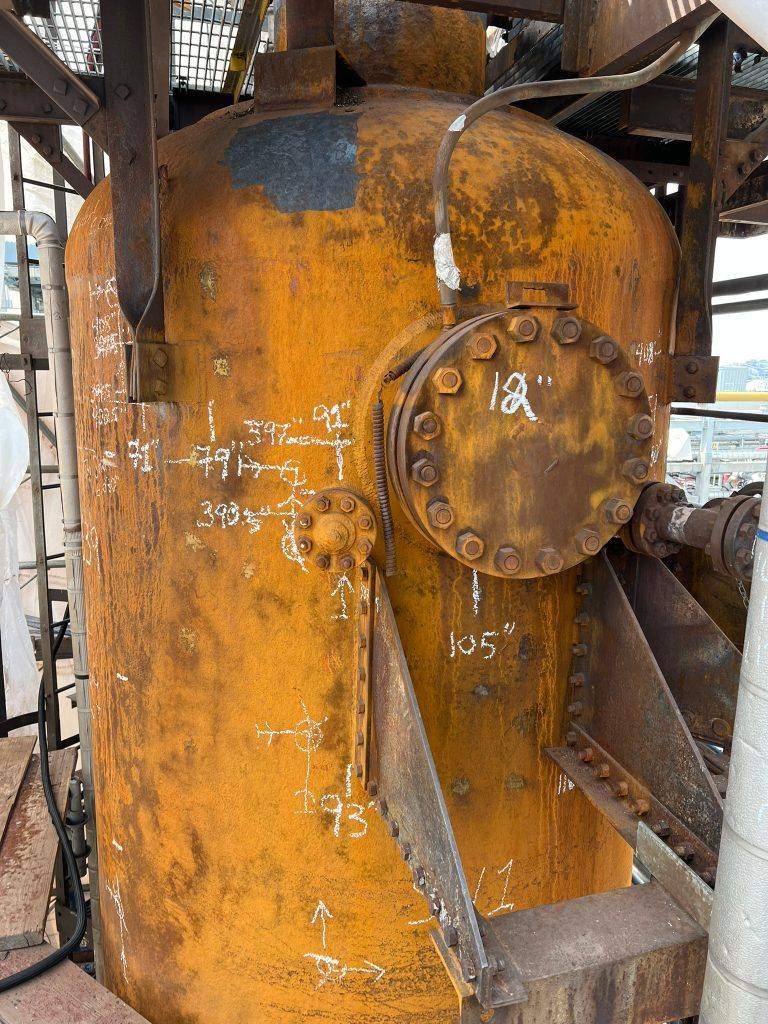
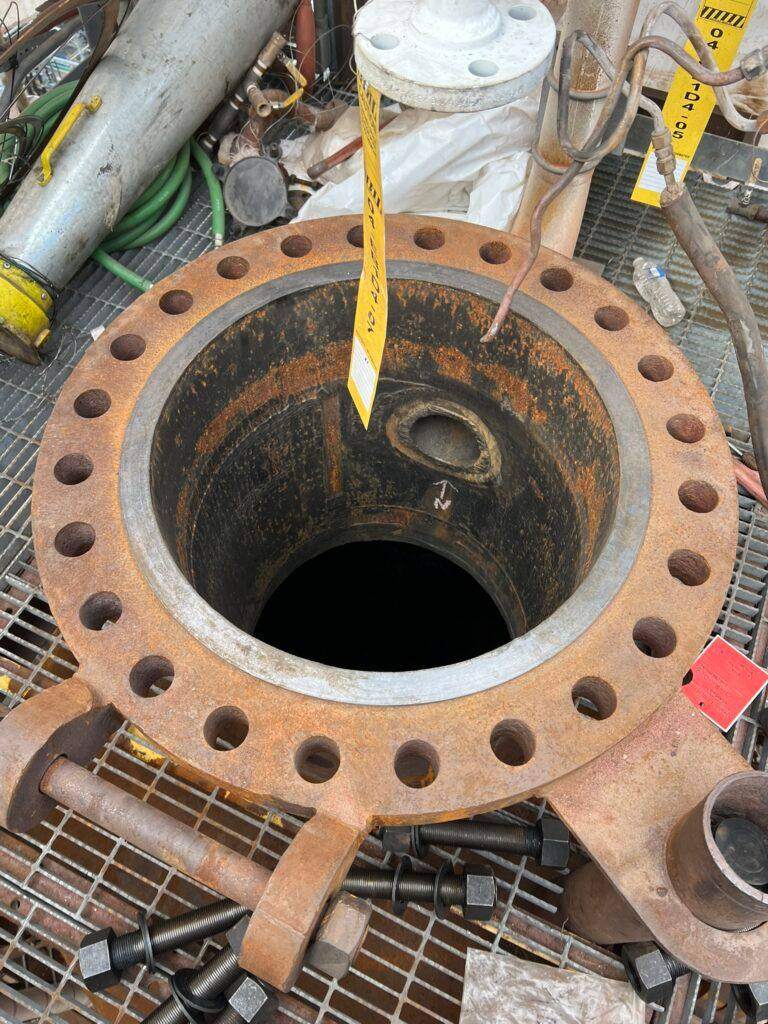 Before
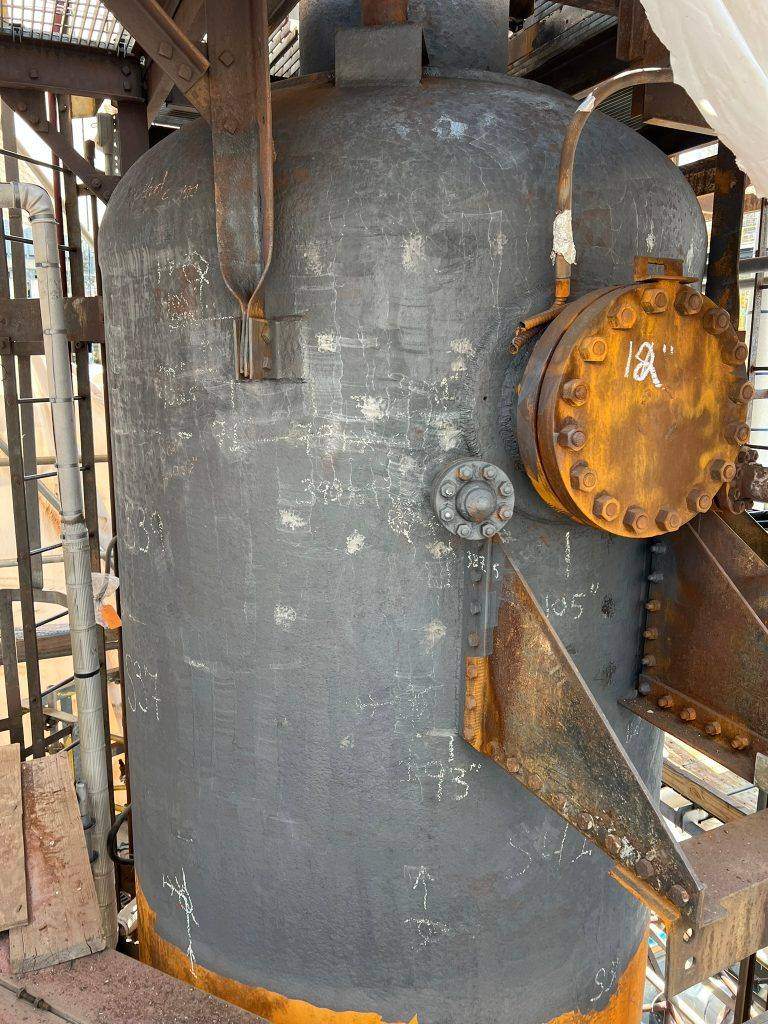
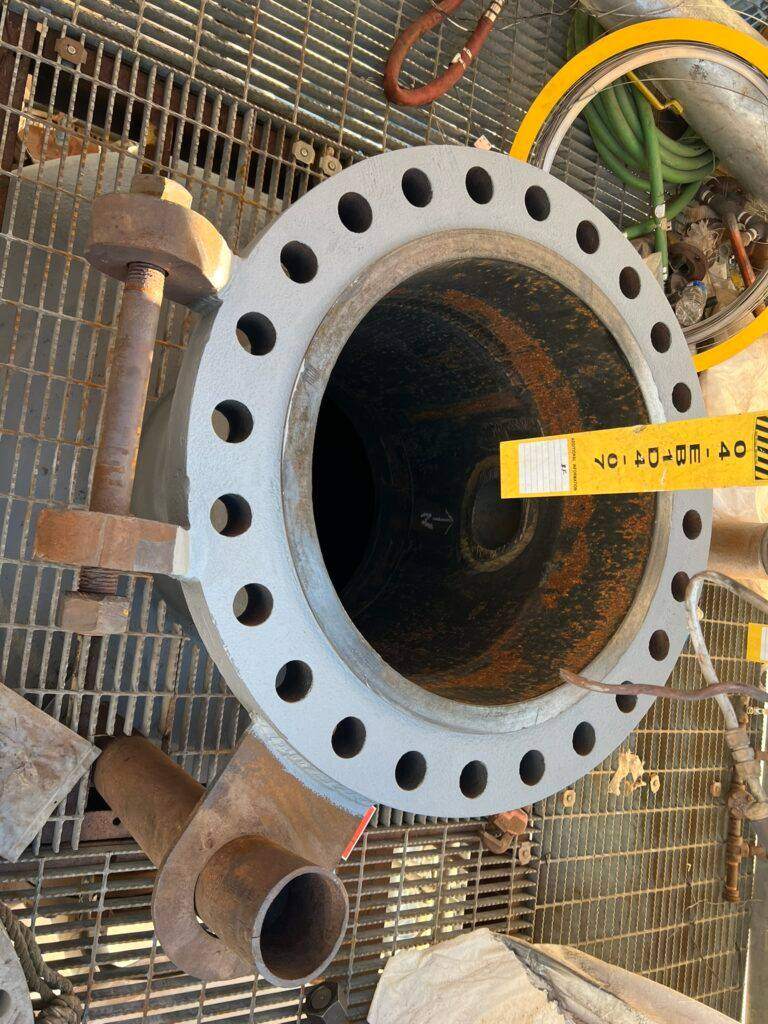 After
What laser ablation cannot do for CUI
Four things it does not do. Any vendor who tells you otherwise is selling rather than advising.
It does not restore wall thickness
Metal lost to corrosion stays lost.
The process removes corrosion product from the surface. It does not add metal back. Ultrasonic thickness measurement and engineering fitness-for-service assessment remain part of the campaign, and nothing about a clean surface changes a fitness-for-service decision.
It does not find CUI
Laser ablation is a cleaning method, not an inspection method.
Extrinite does not provide inspection services. The insulation has to come off and the location has to be identified by your inspection program before there is anything to clean.
It does not see round corners
The process is line of sight.
Deep pitting, undercuts and the back face of a support can retain product the beam cannot reach. Agree the acceptance criterion for pitted areas before the scope is fixed, because the base of a pit is a geometry problem as much as a cleanliness one.
It is not the fastest option on long runs
Where hundreds of feet need stripping and profiling, blasting is quicker.
Extrinite's own test reporting records laser production rates as slower than traditional sandblasting on thick coatings. The method earns its place on localized work, not on bulk removal.
Recoating after CUI remediation
The coating is the thing that stops the corrosion coming back, so the preparation has to meet the coating manufacturer's requirement and be documented against it. Extrinite prepares the steel to the surface profile the coating requires. The coating manufacturer recommends the coating for the service temperature.
Two separate criteria
Your specification will state a cleanliness requirement and a surface profile requirement. They are separate acceptance criteria, measured separately, and a surface can be visually clean while failing on profile.
Confirm with the coating manufacturer and your inspector that a laser-prepared surface meets the specification you are working to, and agree how both will be measured before work starts.
Verify salts before coating
Chlorides are the contaminant that matters most on a CUI surface. Laser ablation removes surface chlorides, but salt levels still need verifying with the project-specified test method, such as Bresle, before coating.Check the recoat window
Product data sheets set recoat times as well as surface requirements. Carboguard 890, for example, has a 90-day recoat time, after which the surface must be abraded before further coats are applied.Record what was achieved
Measured profile, the parameters used, and the condition at handover. On a CUI campaign this record is what connects the inspection finding to the coating warranty.Planning CUI work into a turnaround
CUI is usually discovered rather than planned, which is the single most important thing about scheduling it. The scope grows as the insulation comes off.
Decide the cleaning method before the insulation comes off
The method determines the containment, the permits and the adjacent-work restrictions. Deciding it on the day, with scaffold up and an inspector waiting, is where the schedule goes.Plan for scope growth
Budget for finds beyond the planned locations. An inspection campaign that removes insulation at twenty locations rarely cleans twenty.Settle the acceptance criterion in advance
What cleanliness, what profile, measured how, signed off by whom. Agreeing this with the coating manufacturer and the inspector before mobilization prevents the argument that otherwise happens at handover.Decide rent or crew
A campaign running over weeks with continuous finds usually favors renting equipment and training your own crew. A defined scope in a fixed window usually favors bringing in a crew who already have the capability.Rent the equipment or use our crewFrequently asked questions
For other questions, call 346.217.6583 or email info@extrinite.com.
What causes corrosion under insulation?
Water trapped against the metal surface by the insulation system. It enters through damaged or badly terminated jacketing, penetrations, deluge testing, washdown or condensation, and then cannot escape. Corrosion follows wherever that water sits on steel within the susceptible temperature range, and accelerates where chlorides have concentrated.
At what temperature is CUI worst?
NACE SP0198 gives a susceptible range for carbon and low-alloy steel of roughly 10 °F to 350 °F. Attack is generally most severe in the middle of that range, around 140 °F to 250 °F, where liquid water is present and the reaction runs quickly. For austenitic stainless steel, API RP 583 identifies chloride stress corrosion cracking as a concern above roughly 140 °F where moisture and chlorides are present. Lines that cycle through the range are worse than lines that sit at one temperature.
How do you find CUI without removing the insulation?
Several screening methods exist: pulsed eddy current for general wall loss, profile and digital radiography for external profile changes, guided wave ultrasonics for long-run screening, neutron backscatter for moisture, and thermography for wet insulation. Each has real limitations and none is a substitute for removing insulation and looking. Most programs screen broadly, confirm locally, then remove insulation where the evidence justifies it.
Does laser cleaning fix corrosion under insulation?
No. It removes the corrosion products from exposed steel so the condition can be seen, measured and recoated. It does not repair the damage. Metal already lost to corrosion stays lost, and wall thickness verification and fitness-for-service assessment remain engineering requirements.
Why use laser ablation rather than blasting on a CUI find?
CUI work is usually localized, often at height, and frequently in congested pipe racks next to equipment that cannot be covered in blast media. Laser ablation produces no spent abrasive and uses no water, and other trades can keep working nearby once laser controls are in place. On long continuous runs where throughput governs, abrasive blasting is the better method.
How clean does the steel need to be before recoating after CUI?
Whatever your coating specification and the product data sheet require, measured as two separate criteria: cleanliness and anchor profile. Chlorides should also be verified with the project-specified test method, such as Bresle, before coating. Agree all of it with the coating manufacturer and the inspector before work starts rather than at handover.
Discuss a CUI scope
Tell us the line or vessel, what the insulation came off to reveal, the access, and when the inspection window is. We will tell you whether laser ablation suits it, and say so if it does not.